Archive for category Wyoming Mule Deer Hunting

Trophy Buck from Wyoming

Posted by admin on Thursday, 12 November, 2009

This buck was taken in Wyoming during the 2009 season:

Photos submitted by Paul Baxter

Wolves on the Attack in Wyoming

Posted by admin on Friday, 25 September, 2009

The following story was emailed to me. I consider the source reliable and the pictures substantiate the story. What does this have to do with Mule Deer? I’ll let you figure that out. The author was apparently in Wyoming where wolves are having a hey day on game animals.

———————————–

I had one heck of an experience this past Friday. I was walking into an area I spotted 5 bulls last weekend when wolves started howling, growling and snarling about 300 yds away in the timber below me. It was just getting light so, I hung out for a while hoping to get a look at the wolves. Nothing appeared so, thinking that there were probably no elk in this spot, I headed back to the truck. I unloaded the ATV and was headed to an area called the “Natural Corral” on Bald Ridge.

About ½ mile down the dirt road I came upon a herd of cattle running around in a circle and making all sorts of sounds. The herd parted and 2 wolves popped out to look at me. Just beyond the two was another wolf on the hind end of a cow pulling a chunk of flesh from the cow that was still alive. The two wolves ran to my right and stopped about 50 yds away.

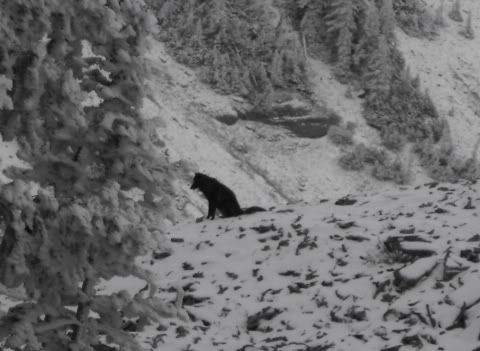
The wolf on the cow jumped off and stood on the road. I charged him with the ATV and he ran to my right and stopped 25 yds. away. I had my .44 mag and could have popped him, but knowing the penalty for killing a wolf, I pulled out the camera instead and took a picture of him while he was running away. It’s a grueling sight to see an animal being eaten alive.

I called 911 to get the local Game Warden, Chris Queen. He called back and was heading to the spot after he finished loading hay. I asked if I should put the cow down since it was still alive. He knew the owner of the herd and said not to finish it since the owner was particular about killing his cattle.

Chris called Mark Brucino, USF&W biologist that handles wolves and grizzlies in the area. Mark called me back to say he was on the way. I told him that I was heading back out to look for elk and would be back later.

The wolves starting to attack the herd again further down the road behind me. I took off down the road, but the wolves were gone. I got back to elk hunting and spotted 3 groups of cows, calves and spike bulls totaling 41. A plane appeared and was flying transect patterns. I knew it must be FWS people. The elk didn’t care for the plane and slowly head back into cover. This was not working for elk hunting so I twisted off the hunt and headed back to the truck. At the kill site I met Mark and an agent with USDA Wildlife Services (formerly Animal Damages Board), Monty Nicholson. Mark said they were trying to pick up any signals from collared wolves. None of the wolves I saw had collars. After explaining my account of the situation and a description of the wolves they made a decision to call in a chopper and hunt them down. The chopper came in and Monty jumped in with a 12 gauge and #4 Buckshot, his standard load for killing wolves and coyotes from a chopper.


Monty had explained that the area I was in is the border for 3 wolf packs; Sunlight Basin, Absaroka and Clark’s Fork. He believes these 3 wolves are lead by a older male wolf that walks with a limp. Because of the injury the older wolf cannot compete with stronger wolves for females and is leading the 3 younger males. The older wolf has a radio collar, however the plane did not pick up the signal.

Soon the rancher and trail riders arrived. Mark wrote out a ticket for the rancher to get reimbursed “7 to 1″ meaning he will get paid 7 times the cost of the 2 yr. old cow. It is based on the assumption that the cow would be able to produce 7 calves during the life span. Of course the money comes from the State even though the Feds brought the wolves into WY and now we have to deal with the mess.

What was the cost of this one situation?

- Time for 1 DOI FWS biologist

- Time for 1 USDA Wildlife Services agent

- Time for 1 WY Game Warden

- Flight time for 1 surveillance plane

- Flight time for 1 chopper

- Payment for 1 cow (.85/lb x 1000 lbs x 7 = $5,950)

So much for wolf management in WY. I could have helped out for the low, low price of one .44 mag round. At least I could have taken care of ¼ of the pack!

———————————-

Story submitted by Paul Baxter

Mule Deer Lousy in Wyoming

Posted by admin on Wednesday, 1 July, 2009


From the Wyoming Game and Fish Department

——————————————

An adult mule deer buck collected from hunt area 80 near Saratoga was found to have a heavy infestation of the exotic louse Bovicola tibialis. This is the first time this nonnative external parasite has been documented in Wyoming

http://wdfw.wa.gov/factshts/hairloss.htm

this exotic louse was thought to be one factor in a large mule deer decline in eastern Washington.”If it affects Wyoming mule deer similarly to how it has affected Washington state mule deer, then we would expect this parasite to be a source of additional mortality in our herds, disproportionately affecting fawns. Although treatable in captive deer, there is no effective treatment for free-ranging deer,” Kreeger said.

Deer infected with exotic lice tend to develop severe skin irritation, leading to excessive grooming by the animal and eventual patchy hair loss and loss of body condition. Lice infestations are heaviest during winter and early spring. Normal seasonal hair loss or molting can usually be distinguished from disease related hair loss because the coat under the molt appears normal and healthy. According to the Washington state site this exotic louse does not affect humans or domestic livestock.

Anyone observing wildlife that appears sick is encouraged to contact their local game warden or wildlife biologist or call their regional Game and Fish office.

Mild Wyoming winter good for Mule Deer

Posted by admin on Monday, 20 April, 2009

Big game

CASPER, Wyo. (AP) – State wildlife officials say the winter mortality rate for mule deer, pronghorn antelope and elk was below normal in most of the state.

The mild winter and the lack of major snow accumulation in lower-elevation wintering ranges produced good conditions for the state’s big game populations.

The Wyoming Game and Fish Department says herds are in particularly good shape in popular hunting areas. That includes the Casper region, south-central Wyoming and the huge deer herd of the Wyoming Range.

For fall hunting season, officials say they expect deer and antelope quotas to be similar to previous years with the possibility of slightly more licenses available for elk.

Wyoming Applications Due

Posted by admin on Tuesday, 10 March, 2009

If you are going to apply for a deer hunt in Wyoming you have until March 15.

For more info go to the States page and click on Wyoming

Wolf Status

Posted by admin on Wednesday, 25 February, 2009

As quoted from the Wyoming Game and Fish :

———————————–

On March 28, 2008, wolves were officially removed from the Endangered Species List in the Northern Rocky Mountains. This includes the entire states of Wyoming, Montana, and Idaho, as well as portions of Utah, Oregon, and Washington. However, a number of groups have filed a lawsuit challenging the delisting of wolves in the Northern Rocky Mountains. Those same groups filed a motion for a preliminary injunction to restore Endangered Species Act protection to wolves while the lawsuit is being heard. On July 18, 2008, a federal judge in Montana granted this injunction, returning management authority for wolves to the federal government.


News Release
Contact: Eric Keszler
eric.keszler@wgf.state.wy.us
July 18, 2008
Cheyenne Headquarters
5400 Bishop Blvd.
Cheyenne, WY 82006
Phone: (307) 777-4594 ▪ Fax: (307) 777-4600

http://gf.state.wy.us

Federal Court Decision Changes Wolf Management in Wyoming
CHEYENNE—A decision issued today in federal court will have significant impacts on the way
wolves are managed in Wyoming. Judge Donald Molloy issued an injunction to suspend the
removal of wolves in the northern Rocky Mountains from the federal Endangered Species List.
Wolves in the northern Rocky Mountains were removed from the Endangered Species List in
March 2008. A number of environmental groups are challenging the US Fish and Wildlife
Service’s delisting decision. Today’s injunction effectively returns management authority for
wolves in the region to the federal government while these legal challenges are heard.
Under state management, wolves in Wyoming were classified as Trophy Game animals in the
northwest corner of the state and Predatory animals in the rest of the state. In the Trophy Game
area, wolves could only be taken by hunters with a wolf hunting license during an open season or
by ranchers who had been issued a lethal take permit by the Game and Fish. In the Predatory
Animal area, wolves could be taken by anyone at any time.
As a result of today’s injunction, wolves can no longer be taken anywhere in Wyoming except in
cases where wolves are in the act of attacking livestock. Ranchers who are experiencing
livestock depredation problems anywhere in the state should contact their local Wyoming Game
and Fish office.

Hunters kill Nice Wyoming Bucks

Posted by admin on Friday, 19 September, 2008

Two Wyoming hunters and their bucks:

Big Wyoming Muley Buck

Trophy Wyoming Mule Deer

Hard Winter in Western Wyoming ?

Posted by admin on Sunday, 13 July, 2008

Wolves or Drilling in Wyoming

Some sources are reporting heavy winter mortality in Western Wyoming mule deer herds. With wolves moving into that area, who knows if the cause is snow or big puppies.

The hunting community, via certain organizations – like the Mule Deer Foundation, is up in arms about the BLM leasing rights to oil drilling companies. Such parties are claiming that the deer herd has diminished by half since the drilling started.

If, indeed harsh winters are killing large numbers of mule deer, the loss may have nothing to do with drilling, but may be purely coincidental to drilling.

A fact that is going unmentioned here is that wolves and grizzlies are increasing their presence in the area in a big way. Both drilling and harsh winters may only be scapegoats.

Wyoming Deer Hit Hard by Winter

Posted by admin on Monday, 7 July, 2008


Two different reports, one in May and one in June indicate a high winter mortality amongst Mule Deer in South Western Wyoming:
—————————————
Associated Press – May 26, 2008 4:45 PM ET

GREEN RIVER, Wyo. (AP) – A mortality survey of Wyoming’s largest mule deer herd indicates that the harsh winter took a toll on the animals.

The annual mortality surveys for the Wyoming Range mule deer herd were conducted this spring near Cokeville, Pinedale and Big Piney and near Leroy in the Bridger Valley.

Wyoming Game and Fish Department biologists and others counted 313 dead mule deer during the Cokeville, Pinedale and Big Piney surveys.

Officials said an additional 340 dead mule deer were found on the Leroy survey in Uinta County, for a total of 653 dead deer.

Game officials noted an unusually high number of adult deer deaths.

Information from: Star-Tribune, http://www.casperstartribune.net

Parts of deer herd hit hard by rough winter
Deaths high around Cokeville, but Pinedale, Daniel fared well.Winter kill deer

By Cory Hatch Jackson Hole, Wyoming
June 4, 2008

A harsh winter and poor forage led to a high number of mule deer deaths for portions of the Wyoming Range herd, including some animals that summer near Jackson.

Gary Fralick, a wildlife biologist for the Wyoming Game and Fish Department, said volunteers counted 313 dead mule deer in the Cokeville area, most of which succumbed to starvation or other effects of winter. Thirty-eight percent of the animals were adult and 58 percent were fawns. An additional 340 winter-killed mule deer were found in the Leroy area.

The relatively high percentage of adult deaths compared with fawns is typical during a harsh winter, Fralick said.

“We had severe snow accumulations and extreme temperatures,” he said. The plants deer feed on “are just in poor shape and are not able to sustain these herds over the hard winter because of drought and because [they] are getting old and decadent,” he said. “On that particular winter range, every three years you can pretty much count on a winter that will take a significant portion of that population.”

Fralick said relatively low winter mortality for portions of the herd in the Pinedale, Big Piney and Daniel areas likely compensated for the hit on the population. Winter mortality for the entire herd likely ranged from 5 percent to 15 percent, he said.

“What that means is the other segment of the deer on the winter range came out in outstanding condition,” Fralick said. “There was good winter survival [in Daniel and Big Piney and the Pinedale Mesa] those deer came through the winter in pretty good shape.”

The mule deer herd is the largest in Wyoming, stretching from Interstate 80 to the Snake River Canyon, and in the past has ranged from 20,000 to 50,000 animals.

During a two-year radio-collar study that started in 1990, Fralick said, researchers documented deer from the Cokeville area that migrated to summer ranges in the Greys River Range, the Grayback Ridge area, the Snake River Canyon and into Hoback Basin.

“There’s major movement off of those winter ranges,” he said. “These deer are migrating from winter to summer range 180 to 200 miles.”

Fralick said the high mortality last winter could mean fewer deer going back to summer range in places like the Smiths Fork, Commissary Ridge and the south end of the Salt Range.

Fralick said hunting seasons this year are already set, and most of those seasons’ limits are already conservative. But he said this year’s winter kill could affect hunters in a couple of years.

“That’s going to translate into fewer 2-year-old bucks in two years,” he said.

Heavy rain and snow this winter and spring could help restore forage in the Cokeville area, but Fralick said it’s too late for some of the plants.

“A lot of the browse plans have been dying over the past five years,” he said. “The ones that are still alive it’s going to benefit, but the trend has been toward dead and decadent on these browse plants.”

Fralick said other factors also take a toll, including human land use, drought and especially motor vehicle collisions.

“We lose 200 to 600 or more deer every year on Wyoming Range highways,” he said.

Bob Wharff, executive director of the Wyoming chapter of the Sportsmen for Fish and Wildlife, criticized the Wyoming Game and Fish Department for not initiating emergency feeding for mule deer populations that were hard hit this winter.

———————–

Comment:

“I’m mad that Game and Fish didn’t feed the deer,” he said. “They have told us numerous times that if the conditions got bad that they would institute an emergency feeding program. It makes no sense to me to not take care of that population. I do think we’re morally obligated to do that.

Wyoming to Hunt 25 Wolves, Idaho goes all out

Posted by admin on Friday, 20 June, 2008

Wyoming Wolf Hunt

Trophy wolf hunting set for Oct. 1
Posted: Wednesday, May 28th, 2008
BY: Joy Ufford

G&F sets limit at 25 wolves for 4 hunt areasWyoming wolf killed

A total “harvest quota” of 25 trophy-game gray wolves, in a hunting season suggested to open Oct. 1 this year in northwest Wyoming, is a new element in this year’s Wyoming Game and Fish (G&F) annual release of proposed hunting season changes.

“The structure of the season will be an Area Harvest Quota Limitation, in which the season for each wolf hunt area will close when the harvest quota for that area has been reached,” said G&F spokesman Eric Keszler. “The proposal will establish wolf seasons and harvest quotas in four hunt areas in the Trophy Game Area of northwest Wyoming.”

A harvest quota is defined in the new regulation draft as “the total number of gray wolves for a single hunt area that may be legally taken by licensed hunters during any single gray wolf hunting season within the area where gray wolves are classified as trophy game animals.”

General licenses will cost $15 for Wyoming hunters, $150 for nonresident hunters.

Four hunt areas

The four new hunt areas are drawn from the designated trophy-game area with exceptions for national park lands. (See Wyoming Game and Fish map.)

The Green River and Gros Ventre Hunt Areas each have a harvest quota of five animals taken with an Oct. 1 opening date and closing on Nov. 30 and Nov. 15, respectively, or when the quotas are reached. The Sunlight (five wolves) and Francs Peak (10 wolves) Hunt Areas would also open Oct. 1 and run through Nov. 30 or until the quotas are filled.

The Gros Ventre Hunt Area (HA 3) begins at the junction of Highway 26/287 with Union Pass Road then follows south along Forest Service Road 600 and the Bridger-Teton National Forest boundary to Highway 189/191 where it follows the highway northwest through Bondurant to Hoback Junction, up to Highway 22 in Jackson and along Highway 22 through Wilson to the Idaho line and zigzags around Grand Teton Park and John D. Memorial Parkway. It excludes all lands within Teton Park and the National Elk Refuge.

The Green River Hunt Area (HA 4) begins where Highway 26/287 crosses the west boundary of the Wind River Reservation, south to the Continental Divide then southeast along the Divide to go west along the Middle Fork of Boulder Creek to the BTNF boundary and northwesterly to Union Pass Road.

The Sunlight Hunt Area (HA 1) begins at the junction of Highway 120 at the Montana state line, runs south to the intersection with Highway 14/16/20 in Cody, then west to Yellowstone and along the park boundary to the state line and back to Highway 120.

The Francs Peak Hunt Area (HA 2) begins at the intersection of Highway 120 and Highway 14/16/20 in Cody, runs south along the highway to the Greybull River, southwest along the river to the Shoshone national Forest, south along that boundary to the Wind River Reservation and west and south to where it meets Highway 26/287, then to the east boundary of the John D. Memorial Parkway and up along Yellowstone’s east boundary to meet back at highway 120 in Cody.

Draft rules

Draft regulations state a hunter must confirm whether or not a hunt area’s quota is met before hunting there. Only legal firearms and archery equipment can be used; it is illegal to use radio-tracking equipment to take a trophy wolf, the new regulations say.

The bag and possession limit for licensed hunters will be one wolf during the calendar year and that can be any gray wolf in the applicable hunt area.

Hunters must report taking a trophy wolf within 24 hours by calling (866) 373-5805 any time of day or night. They also must retain the skull and unfrozen pelt, with visible evidence of sex attached naturally, and present them to a district game warden, district wildlife biologist or G&F personnel at a regional office within five days for collection of biological samples. Radio-tracking devices such as electronic collars or ear tags must be surrendered to the G&F as well.

Conservative start

G&F Wildlife Assistant Chief Bill Rudd said last week the proposed wolf hunting season and harvest quota are “an extremely conservative approach to wolf hunting in Wyoming.”

U.S. Fish and Wildlife Services (FWS) Wolf Recovery Coordinator Ed Bangs, who led the recovery project to the gray wolf’s March delisting, agreed this week.

“I think the WGFD recommendation of 25 tags as a start is a good one,” he said.

Bangs said he expects most prospective Wyoming wolf hunters will buy tags to go along with another big-game hunt.

“Most hunters won’t ever hunt for wolves but take them while hunting something else,” he said. “Same thing here – it will be elk and deer hunters that harvest wolves during the fall big game season.”

The Idaho Fish and Game Commission met last week and chose to allow higher hunting quotas to take Idaho’s wolf population back to its 2005 population level.

Bangs said, “…In Idaho the (Fish and Game) Commission ignored the IDFG recommendations and passed the maximum wolf kill under wolf-hater pressure, to get the wolf population down to the lowest level in their management plan (but still 518 wolves) – so we’ll see how good (G&F) is at ‘wolf’ politics.”

The IFGC set a wolf population goal of 518 wolves and adopted seasons, limits and rules for this year.

The Idaho Wolf Population Management Plan, approved in early March, calls for managing wolves at a population level of between 2005-2007 levels (518 to 732) wolves for the first five years after delisting. With an annual estimated growth rate of 20 to 30 percent, Idaho’s population could exceed 1,000 wolves before the state’s new hunting seasons open, Sept. 15 and Oct. 1. Idaho hunt areas will be open through Dec. 31 with possible season extensions if quotas aren’t met.

In Wyoming wolves are increasing at about 24 percent annually, said Rudd.

“Wolves… in Wyoming and can sustain much higher harvest than we are proposing through hunting,” he said. “Removing some wolves through controlled hunting can also help prevent wolf-livestock conflicts in some cases.”

More information

The proposed wolf hunting season, hunt areas and regulations are included in G&F’s “Chapter 47: Gray Wolf Hunting Seasons.” To see proposed wolf hunting seasons and associated information, visit http://gf.state.wy.us/services/education/wolves/index.asp.

A public comment period on this proposal as well as other G&F hunting issues is open through 5 p.m. on July 3. The G&F Commission will take actions on the proposed trophy wolf season and other hunting issues when it meets in Dubois, July 30-Aug. 1.

Public meetings are planned across Wyoming but mainly in the western part of the state for discussion and comments on the wolf season and other 2008 hunting issues including mountain lion seasons, furbearing and trapping seasons, taxidermy regulation and issuance of licenses, special points and interstate game tags.

G&F will hold the Pinedale meeting June 10 at 7 p.m., at the Pinedale Library. On June 11, a meeting will be held at 7 p.m. at the Antler Inn. Other meetings are set for Green River (June 9), Laramie (June 9), Lander (June 10), Sheridan (June 11), Cody (June 12) and Casper (June 12).

Copies of all regulation changes and seasons can be viewed at the public meetings or by contacting the Casper Game and Fish office at (307) 473-3400. All comments must be in writing and must be submitted at the public meetings or mailed to: Wyoming Game and Fish Department, Wildlife Division, ATTN: Regulations, 3030 Energy Lane, Casper, WY 82604.