- Over 55,000 mule deer roam BLM public lands in the Rock Springs District.
- Mule deer inhabit every major vegetation type in western North America and every climate zone except arctic and tropics. Mule deer in high elevation ranges may migrate up to 50 miles between summer and winter range. Snow depth and forage availability is considered to be the dominant factor in population control by many.
- Mule deer occupy a wide range of habitats. Food, cover, arid water requirements change with the seasons. Mule deer often must compete with livestock grazing practices and other human-caused disturbances. Proper land management can benefit deer.
- Mule deer gain weight during spring, summer, and fall. Deer must be in excellent condition in the fall of each year to survive the harsh winter weather.
- Deer eat a wide variety of foods. The major foods eaten by mule deer include sagebrush, serviceberry, snowberry, rabbitbrush, aspen, bitterbrush, juniper, willow, mountain mahogany, grasses, and forbs. In winter, more shrubs are eaten than dead forbs and grasses. Shrubs are alive and provide more protein and carbohydrates. Mule deer in North America have adapted to these long periods of nutritional stress caused by winter. Protection from human disturbance helps mule deer survive winter stress periods.
- Males gain and lose weight more rapidly than females.
- Both sexes essentially starve a little each day during severe winters because they can’t eat enough forage to maintain their body weight.
- Good quality habitat may keep them from starving to death except in the very worst of winters.
- Antler growth in males begins in the spring. As fall and the rut approaches, the males’ necks and shoulders swell, they become hyperactive and aggressive and begin to eat less food.
- Mule deer have their young in riparian areas and aspen stands when they are available.
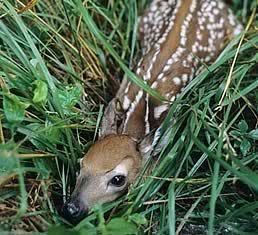
- Under good conditions, most mule deer does have twins. Fawns average 7-8 pounds at birth.
- Mule deer nearly disappeared from the plains by the late 1930s, probably due to the combination of excessive hunting, several periods of severe drought, complicated by over-grazing by domestic livestock and several extremely severe winters. Mule deer populations have rebounded in most of their range.
Source: Bureau of Land Management Rock Springs District

Here in Northern Arizona, we have a rainy
season referred to by locals as the Monsoon Season. This year and last, it began about the first week of July and lasted until the end of July. Just coincidentally, this is the time when most of the fawns are born. In other areas, fawn mule deer may be expected to be born about the first week of June. I have seen several does this week, that look like they are about ready to pop, but still haven’t shed that excess weight.
When I moved to Arizona, I expected that fawns would be born much earlier – even April. This assumption was based on the, apparently, false logic that the further south you go, the earlier spring arrives. The earlier the spring, the earlier the fawning season. Now the question that might be on your mind is – wouldn’t the breeding season have to be later?
In order for fawning to occur in late July, breeding must occur in late December – early January. Because winter doesn’t get serious until that time period, mule deer don’t have much cause to congregate. Breeding doesn’t occur until bucks and does get together. During the summer and even into late fall, mule deer in this part of the world are spread as thin as the hair on top of my head.
That’s my twist on when fawns are born and why. Pay attention and see what you observe.
“If God didn’t want us to eat MULE DEER, He wouldn’t have made them out of meat”
——————————————
“You’ll often read that venison contains a lower level of cholesterol than beef, but this just isn’t true. This article, excerpted from my book, “Making the Most of Your Deer” (2000), contains USDA data, cut-for-cut.”
——————————————
EXCERPT FROM “MAKING THE MOST OF YOUR DEER” BY DENNIS WALRODfrom Chapter 6: “The Cholesterol Wars”
Nutritional Value of VenisonVenison, when properly prepared, is a culinary delight that holds its own in the company of fine wines and other condiments. The meat has a fine-grained, interesting texture, yet is tender without being mushy as are some of the more expensive cuts of domestic meats. But the good news doesn’t end here. Not only is venison delicious, it also is better for your nutritional well-being than are most commercially available meats. In this day and age when so many tasty items have been found to be either worthless or even potentially harmful to your health, rest assured that venison compares favorably with the supermarket alternatives. Venison is low in fat and calories and is high in minerals and vitamins. It also is free from chemical additives, synthetic growth hormones and other nasty substances.
Some of venison’s nutritional superiority exists solely by the default of our modern meat raising systems. Still, the basic fact remains that whitetail deer are highly efficient processors of the natural foods they eat. The buds, herbs, acorns, wild fruits, and other browse in a deer’s diet are effectively converted into muscle, and the benefits of this natural food fare are passed along to those of us who enjoy venison. It’s truly an “organically grown” product!
…….it’s obvious that venison ranks very high by modern dietary standards. For one thing, venison fat content, and consequently the caloric count, is relatively low. Even when all excess fat has been trimmed from a beefsteak or pork cut, there still remains a high level of fatty tissue entwined within the muscle fibers (we call it “well-marbled”) of domestic red meat. When a portion of venison is trimmed of fat, the remaining meat is 97.8 percent fat-free. Now that’s what you can properly call lean meat! Venison also contains comparably high levels of calcium, magnesium, phosphorous, and iron. These minerals are essential to our well-being, and it’s great that we can partake of them while enjoying a gourmet venison meal. And let’s not forget the vitamins; venison scores high in thiamine, riboflavin, niacin, plus Vitamins B6, B12, and E. In fact, it has been calculated that a one-pound venison steak contains more than the full recommended daily adult allowances for thiamine and niacin and a major share of the recommended riboflavin allowance. These are natural vitamins, products of nature rather than of industry, and they come to you indirectly in venison from the foods of the forest.
Cholesterol in Venison? – the Real Story, Right Here
Everyone knows that the cholesterol level in venison is lower than in beef and pork…right? Wrong! I wish that I could claim that cholesterol in venison was low, right along with the established benefits of higher vitamins and minerals and lower fat content, but that just wouldn’t be true. It turns out that, yes, although certain parts of a deer (such as the round steak) are slightly lower in cholesterol than some other parts of beef and pork, the total edible venison from a deer contains a slightly higher average cholesterol than do beef or pork. To get an accurate comparison, you need to look at the same cuts of meat from a beef cow or pig as you do for a deer, because they’re all different! Don’t just take my word for it, go to the USDA National Nutrient Database at:
http://www.nal.usda.gov
and see for yourself. This remarkable Website lists the nutritional values for virtually all of the more common meat cuts from most domestic animals and some game animals, and further provides good nutritional data for cooked versus uncooked meats, and fat-trimmed versus cooked as-is. The cholesterol content of any animal is tied more directly to the lean meat than to the fat content of the animal. You might be surprised to learn that fat contains very little cholesterol! So it’s a see-saw…calories from fat, or cholesterol from the lean meat. Pick your poison…but please add the right spices first!
_____________________________________________________ Gourmet Food on a Survivor’s Budget
Good food is somewhat expensive, sure, but the cost of true gourmet food is out of sight. Just to have the experience of grilling a prime beefsteak in the backyard, the average person might have to scrimp on other groceries. We would like to be able to experiment with different sauces and exotic recipes, but with meat prices so high we restrict our culinary adventures to within the affordable and commonplace. Instead we often limit our skills to the preparation of tossed salads and hamburger dressings. Why take a chance with big money, right?
Well, with a supply of venison stocked away in the freezer, we can experiment to our heart’s content. Make no mistake about it, venison qualifies as a gourmet delicacy in every sense of the word. Venison has a distinctive flavor, responds well to special cooking techniques, is uniquely different from domestic meats, and last but not least, is difficult to obtain. Venison has the status of exclusiveness because wild venison cannot be legally sold or purchased. (The venison that sometimes appears on some restaurant menus originates from licensed deer farms. These pastured deer are fed commercial foods and consequently, the taste of their venison is somewhat different.)
Restaurants charge exorbitant prices for such exotics as truffles, caviar, morels, lobster, escargots, and other choice items that are obtained chiefly not from domestic sources but from the natural world.
But then, so would venison be expensive; that is, if you could buy it. If you had to pick up the tab for someone else’s hunting trip every time you had a venison meal, you would soon come to understand the real meaning of the words “exclusive” and “expensive.” The fact that we hunt for pleasure, rather than for food or profit, does not alter the fact that venison has all the qualifications of a gourmet food. A lot has been written about how venison can be made to taste just like beef so that those people who profess not to like wild game would not be able to tell the difference. That certainly is true; with a little cover-up here and there, venison can be made to pass for beef. But why would you want to do a thing like that? Why try to alter a gourmet food into something ordinary?
Venison should be appreciated for its own merits, much the same way that you relish a lobster for its sweet, succulent flavor. Sure, you could prepare a lobster in ways that would disguise the piquant odor of the ocean, and pass it off as farm-raised. Similarly, venison should not automatically be dummied up with strongly flavored sauces solely to change the taste of it into something that could be mistaken for a domestic meat. Take the approach of the gourmet and limit the use of sauces to only those which will enhance the natural taste and flavor of venison. A fine wine, good music in the background, candles (optional), the children either young and in bed, or grown and off someplace (also optional), and a fine meal of venison with the proper accompaniments–what else could you possibly ask in the way of a gourmet meal of fine cuisine?
The Tragedy of Modern Domestic Meats
Sometimes you can get as many chuckles from reading the advertising hype on a package of processed supermarket meat as you can from the comic section of the weekend newspapers. Seems that meat is inevitably packaged under brand names that are designed to evoke images of sunshine, shade trees, sparkling brooks and so on, scenes where children soar kites under perpetually blue skies and Mom is in the kitchen forever baking apple pies. This advertising often contains a picture, typically one that shows a smiling, straw-hatted farmer feeding only two or three head of livestock. Even the livestock are smiling (although somewhat ironically). You get the mental picture, standing there in the supermarket, that the contents of the package you are holding were grown back in the Good Old Days and then were mysteriously transported into the Here and Now, just for you. You even feel strangely reassured that those little piggies (or whatever) in the picture received many affectionate pats on the rump during their rich and full lives down on the farm.
“Sustaining populations subjected to hunting pressure requires species capable of rapid and consistent reproduction. Deer qualify.“

The above quote comes from Dr. Scott Shalaway of West Virginia.
I am open to discussion or to contention in regards to what I am about to say, but here is what I believe:
First, the earth was created. The earth, mule deer, predators, people…. they didn’t just happen. I believe the creator had humans foremost in his mind and that humans are “factored in” to how the earth functions. Humans are “natural”. In fact, the primary purpose of the earth is for humans. What does this have to do with the price of cheese? It is a long story.
Secondly, there are prey and there are predators. Relative to mule deer – human hunters are part of the predator group. Hunting mule deer for food and/or for whatever other reason, has been happening for a long time. As humans, we can decide whether or not our needs, wants, and desires for mule deer consumption are a higher or lower priority than those of the other predators, i.e., lions, wolves, bears, coyotes.
I believe that the creation of the earth is such that, in the absence of human predators ( for whatever reason ) predators and prey have some pre-defined balances which keep prey populations from getting too large. This balancing act is not perfect in the sense that prey never exceed carrying capacity, but it serves the purpose overall without divine intervention. We humans both interfere with that balance and control it. To state this bluntly, we can have as many deer as we want, as long as we like the consequences.
When we humans decide that we need more prey ( such as mule deer ), then we simply reduce the other predator populations and wala population explosion. Then, we are the control instead of the other predators. This is how we provide for hunting. This is what game management is all about ( or supposed to be about ). Mule deer aren’t quite as prolific as rabbits, but almost. Overall, twins are the norm.
So without factoring in death, deer populations go like this: Adam and Eve buck and doe have two fawns, male and female. The next year, Adam and Eve have two more. The next year, Adam and Eve have their two, and daughter#1 has one. The next year Adam and Eve have two, daughter#1 has two, daughter#2 has one, and grand-daughter#1 has one. And so on and so forth. Assuming I am doing the math correctly: by year, the population looks like this: 2 -> 4 -> 7 ->13 ->24. This is not exactly linear and not exactly exponential, but you get the idea.
I don’t know how my dad figured it out, but in my youth he did not want me killing does, and told me that, if I killed a doe – I would be killing the equivalent of 25 deer in five years. He was about right.
Thirdly, if our game “managers” took the right actions, we could have mule deer ( or rabbits, quail, grouse, whatever ) coming out of our ears. We would control these populations by hunting ( as in the good ol’ days ) vs. by employing the other predators. Game managers are, more and more, moving toward putting human hunters last on their list of priorities, but it doesn’t have to be that way. The agencies need to hear from us loud and clear “we want and expect more game”, if in fact, that is what we want and expect. We are, after all, paying the bill.
This article came from Vindy.com in Youngstown, Ohio:
I am going to do a series of posts about this topic and use this article as a foundation for those posts
——————————————
Published: Saturday, November 17, 2007
Sustaining populations subjected to hunting pressure requires species capable of rapid and consistent reproduction. Deer qualify. Over the last century, studies of deer biology and its response to hunting pressure have resulted in thousands of research papers, books, symposia and countless graduate degrees in wildlife biology.
Two classic cases, familiar to every wildlife biologist, stand out as the foundation of deer management in North America.
From 1906 through 1923, government hunters and trappers removed predators from the Kaibab Plateau along the north rim of Arizona’s Grand Canyon. During that period, agents removed 781 mountain lions, 30 gray wolves, 4,889 coyotes and 354 bobcats.
The Kaibab mule deer population responded in spectacular fashion. When predator control began, the mule deer population was estimated to be 4,000. Under greatly reduced predator pressure, the deer herd exploded to more than 100,000 in less than 20 years. During the winter of 1924-25, the population crashed. Ever since, wildlife biologists consider “Kaibab Plateau” to be synonymous with the dangers of predator control as a way to protect game populations.
Rarely, however, is population biology so simple. In 1970, Graeme Caughley suggested that the mule deer population explosion on the Kaibab Plateau was due more to the recovery of the range than to the disappearance of predators. It turns out that while predators were being removed from the area, so were domestic livestock. At least 200,000 sheep and 20,000 cattle were removed at the same time the predators were being removed.
Caughley argues that deer flourished not because predators disappeared, but because the recovering range provided a virtually unlimited food source. We’ll probably never know which factor was more important, but a case can be made that both predator control and unlimited food can trigger a population explosion.
Just a few years after the Kaibab “experiment,” another classic field study unfolded. In the 1920s a Detroit industrialist, Col. Edwin S. George, purchased 12 adjoining farms, a total of 1,146 acres, in southern Michigan. In 1930 he donated the property to the University of Michigan for use as a natural laboratory, though he maintained one house and 40 acres for his personal use. After George’s death in 1940, his heirs gave complete ownership and control to the university.
In the 1920s there were virtually no deer in southern Michigan. In 1927 Colonel George erected a 7.5-foot-high fence around the entire site, and the following year, he released six white-tailed deer, two males and four females, inside what today is known as the George Reserve. The deer were trapped on Grand Island in Lake Superior, and the does were thought to be pregnant.
The George Reserve deer herd thrived. Six years later in 1933, biologists conducted the first annual deer drive census to assess the population. They counted 130 deer; in six years the population grew from six to 130, an astounding rate of population growth.
Since that initial deer drive census, this deer population has been intensively studied and manipulated. Various rates of hunting pressure enabled biologists to study and evaluate white-tailed deer population growth under a variety of conditions. Dale McCullough, a University of Michigan professor, published the results of decades of research in “The George Reserve Deer Herd” (1979, University of Michigan Press).
The results of the Kaibab and George Reserve field experiments demonstrated that deer populations, when provided with quality habitat and minimal predation, can grow explosively. Biologists call this exponential population growth. Theoretically, all species grow exponentially until they reach limits imposed by the environment (habitat quality, food availability, space, predator pressure, etc.). Reproductive characteristics such as gestation period, litter size, litters per year, and age at first breeding determine how quickly such a population explosion can occur.
The innate reproductive capacity of deer and other game species is the biological basis for annual harvests. By monitoring population numbers and habitat quality, biologists can adjust hunting pressure on game species annually as populations fluctuate.
Clearly, wildlife management is complicated. This is probably the best reason politicians, unschooled in population biology, should resist the urge to meddle and allow professional biologists to do their jobs.
Send questions and comments to Dr. Scott Shalaway, R.D. 5, Cameron, WV 26033 or via e-mail to sshalaway@aol.com.
Since the gestation period for mule deer is about 210 days, if you know when the rut occurs, then you will know when to expect baby deer. Or, in like manner, if you know when the fawns are born, then you know when the rut occurs. In my home area of North Central Arizona, the firs
t fawns are born about the end of July. This may be a surprise to some. It was a surprise to me. The peak birthing period here is mid August. That is when the typical Arizona monsoon hits. This timing is about 2 months later than, say Western Colorado. If I work backwards, that means our local rut is around mid to late January.
It just so happens that, here in Arizona, I can buy an over-the-counter archery tag that lets me hunt during the rut in certain areas.
Since I am a Mule Deer Fanatic, and a serious student of the Mule Deer, I watch the mule deer near me with keen interest. I know that the fawns that are being born are disappearing just about as fast as they hit the ground. I know that the does separate themselves from the other animals just before fawning. I know that they typically give birth in the middle of a park, which is what I would expect of an antelope. I presume this is a predator evasion strategy. It doesn’t seem to be working too well, however. There are so many coyotes in our area that the deer, and the small game, for that matter, don’t have much of a chance to survive. I see these deer every day – so I can tell when a doe is pregnant, and I can tell when she has delivered. If I see fawns with their mother, and then they disappear, I deduce a predator problem. We do not have a habitat problem per se, and we do not have winter kill.
Last year, we ended up with about 0.5/1.0 fawns per doe. That’s pretty sad. It looks like it is going to be even worse this year. Have you ever wondered what this ratio should be? If you were a deer rancher, you would want to net at least 1.5/1.0 fawns per doe. Is that possible, you ask. Why, yes it is. If our agencies were even half good game managers, that is what we could expect from them. This type of ratio is essential to a growing herd and to having surplus deer. That is why we have hunting – because of the capacity of deer herds to produce a surplus. Today, we are giving the lion’s share of that surplus capacity to predators.
It is “normal” for a “heifer” doe to have a single fawn for her first birthing experience at age 2 1/2. After that, until she goes through menopause, she will typically have twins, occasionally triplets. Let’s say that a doe will have seven birthing experiences in her lifetime, then we could expect her to deliver 11-13 fawns. I should interject here – this is why we don’t kill does. About 55% of the fawns will be buck fawns, so we could expect something like seven buck fawns and six doe fawns from a single, healthy doe. By the time a doe expires, let’s say, at age ten, between her and her offspring, there would be approximately 340 fawns delivered, of which about 190 would be bucks.
Thinking about these prospects should make any Mule Deer Fanatic happy. Then you think about the current state of mule deer mis-management and you get sad.
So, keep an eye on your own deer herd and see what you can learn. If you see low fawn/doe ratios, you can start killing coyotes.
Preference Points for Elk, Deer and Antelope
FOR NONRESIDENTS ONLY
An optional Preference Point system was instituted beginning in 2006 for Elk, Deer and Antelope. In 2007, hunters, who were awarded a Preference Point in 2006, will have an advantage in the license draw.
Beginning in 2007, the Department shall allocate not less than seventy-five percent (75%) of the available nonresident Elk, Deer and Antelope licenses to a preference point drawing and twenty-five percent (25%) of the available nonresident Elk, Deer and Antelope licenses will be assigned to a random drawing in which all unsuccessful applicants from the preference point drawing shall be placed.
For party applications, the number of preference points for each applicant within the party will be averaged for the preference point ranking to be used for the ranking in the preference point drawing.
NEW for hunt year 2007 is the TIME PERIOD for only purchasing a Preference Point without applying for a hunting license. Purchasing ONLY A PREFERENCE POINT can ONLY OCCUR from July 1, 2007 through September 30, 2007. This is a CHANGE from 2006. DO NOT ATTEMPT TO PURCHASE A PREFERENCE POINT ONLY during any of the initial license application periods. YOU MUST WAIT until July 1st to purchase only a Preference Point. The price is $50.00 for Elk, $40.00 for Deer and $30.00 for Antelope ($10.00 for youth for each species). There is NO APPLICATION FEE TO PURCHASE A PREFERENCE POINT ONLY.
REMEMBER, a PREFERENCE POINT ONLY PURCHASE is DIFFERENT THAN an application for a license with a PREFERENCE POINT OPTION. THE PREFERENCE POINT OPTION takes place during the initial license application periods. If you elect this OPTION when applying for an Elk, Deer or Antelope license, the fee, which you must remit with your application for a regular elk license, is $543.00 ($12.00 application fee, $481.00 license fee and $50.00 preference point fee). Regular deer license is $313.00 ($12.00 application fee, $261.00 license fee and $40.00 preference point fee). Regular antelope license is $268.00 ($12.00 application fee, $226.00 license fee and $30.00 preference point fee).
To purchase a Preference Point, an applicant must be at least eleven (11) years old at the time of application and be at least twelve (12) years old by December 31 of the year of application.
An applicant may fail to apply for a license or fail to purchase a Preference Point for one (1) year without losing accumulated Preference Points. However, if an applicant fails to properly apply for a license or purchase a Preference Point for two consecutive years, the accumulated Preference Points will be deleted.
The Preference Point system is designed to award a point for each unsuccessful draw attempt in a hard to draw area for individuals who elect the PREFERENCE POINT OPTION and remit the additional Preference Point fees, yet not penalize those who wish to list an easier to draw area on their second or third choice. If a person draws on the second or third choice when electing the PREFERENCE POINT OPTION, a Preference Point will be awarded even though a license is issued. If the person is successful in drawing his or her first choice, then all Preference Points are deleted but the preference point fee paid for that year is refunded. DRAWING A SECOND OR THIRD CHOICE DOES NOT CAUSE PREFERENCE POINTS TO BE DELETED.
Some suggestions when applying for licenses with the PREFERENCE POINT OPTION: DO NOT apply for an easy to draw area for your first choice. If you do and are successful, then all of your accumulated preference points will be deleted and the odds of drawing a license in a hard to draw area may be greatly diminished for the next couple of years. For example, a person applying for Antelope might list area 57/type 1 as a first choice and area 26/type 1 as the second. Based on past years, drawing odds in area 57/type 1 are less than ten (10) percent but area 26/type 1 has been a 100 % draw on all choices. Under the Preference Point system, a person, if not drawn for area 57 would be issued a Preference Point for Antelope if he or she elected the PREFERENCE POINT OPTION, and would also be awarded an area 26 Antelope license if the additional Preference Point fee was remitted as identified above.
To summarize, please remember there is a difference between PREFERENCE POINT ONLY PURCHASES and an application for a license with the PREFERENCE POINT OPTION. A PREFERENCE POINT ONLY PURCHASE APPLICATION (no chance to draw a license) CAN ONLY be submitted from July 1, 2007 through September 30, 2007. An application for a license with the PREFERENCE POINT OPTION can only be made during the applicable initial draw periods.
If you have any doubt, please call (307) 777-4600 or go to our Web Site at http://gf.state.wy.us where the difference between PREFERENCE POINT ONLY PURCHASES and PREFERENCE POINT OPTIONS WITH LICENSE APPLICATIONS will be further
explained.
Only the females. They blink them in rapid succession when trying to attract a big buck.
Seriously, yes – mule deer have eyelashes. They have a regular set, similar to humans, and then an extra set made up of long (2 inches) black hairs, above and below the eye. Had you ever noticed? When browsing in thick forage or when running through thick cover, these extra eyelashes may come in handy. We still don’t know if they help does attract bucks, but suppose they do.
Can you see eyelashes in the accompanying photo? No? Look closer.

Happy hunting and may the Force be with you