Archive for category Colorado Mule Deer Hunting

Mule Deer attacks Woman

Posted by admin on Monday, 12 April, 2010

October 2009 Colorado Deer Story

—————————————

A young buck mule deer gored a 63-year-old woman near Florissant on Monday after she apparently called to the animal in an attempt to pet him, officials from the state Division of Wildlife said today in a news release.

Responding to her calls, the deer came closer, then lowered his head and charged the woman, identified as Joan Nutt, who was at her sister’s home when the attack occurred, officials said in a statement. She grabbed one of the deer’s antlers in an attempt to fend him off, but he knocked her down before she could escape.

A motorist driving by the home saw the deer stomping Nutt, stopped to assist and was able to scare the animal away before contacting the Teller County Sheriff’s Office.

Emergency medical personnel took Nutt to Pikes Peak Regional Medical Center in Woodland Park. The deer’s antlers and hooves left cuts on her elbow and lower arm, in addition to minor wounds on her hands, upper leg, stomach and hip. She was released from the hospital after surgeons placed a pin in one of her arms, said Michael Seraphin, a spokesman for the Wildlife Division.

The deer was tranquilized and later euthanized because officials deemed it a “threat to human safety.” His carcass was sent to a Fort Collins lab for additional testing, but results haven’t been released. Seraphin stressed that wildlife officials don’t lightly decide to euthanize an animal.

Medics treating Nutt at the scene said they had to continually chase the buck away because he kept returning to the area. That could be an indication that someone had tried to domesticate and treat him as a pet, said wildlife officer Aaron Flohrs, who was at the scene.

The family said that the deer frequently visited the property, but there was no clear evidence that Nutt was feeding him. Nutt reiterated today that the family hadn’t been feeding him either, Seraphin said. The home is located in a rural subdivision, away from designated camping areas.


Apply now for a Colorado Deer Tag

Posted by admin on Friday, 2 April, 2010

The application deadline is April 6. If you want you can apply for a preference point as your first choice and then apply for a hunt as your second choice. If you draw the hunt then you get no refund and lose your accumulated points for the hunt. If not then you pay $25 plus the application fee and keep your preference point. Or, if you like you can apply for up to five hunt choices, and if you don’t draw then you may keep (and pay) for a license and get a preference point that way. Cost for a non-resident is $329 plus or minus.

Colorado Deer Applications due April 6

Posted by admin on Sunday, 28 March, 2010

Keep applying and building up your bonus points. Maybe you will draw.

Good Luck

More Cat Problems

Posted by admin on Tuesday, 9 February, 2010

In Helena, Montana they kill mule deer for being a public nuisance. Heaven forbid that anyone should kill a mountain lion – public threat or not.

—————————————-

Jan 7, 2010

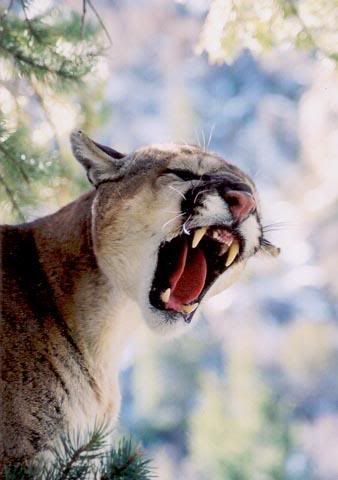
BOULDER, Colo. — The Colorado Division of Wildlife captured a mountain lion on Boulder’s University Hill Wednesday.A pair of dogs chased the cougar into a tree near Sixth Street and College Avenue. That’s where Division of Wildlife officers sedated the animal.Officers attached a radio collar to the mountain lion before he was relocated. He is now part of a 5-year mountain lion study being conducted by the Division of Wildlife. The study is in its second year.

The Division of Wildlife is tracking the mountain lion’s home range. “We are also trying to find new tools for managing lions that we can add to our arsenal beyond relocating or killing them,” according to DOW spokeswoman Jennifer Churchill.

Colorado Cat Problems

Posted by admin on Thursday, 28 January, 2010

I estimate there are now more than ten times as many cougars in the state of Colorado as there were when there was $50 bounty.  Nevermind that the Colorado deer herd has not recovered since 1988. It is time to go back to a bounty. I wonder if this lion would have been relocated after killing one of those pesky students?

—————————————-

Colorado wildlife officials tranquilized a male mountain lion at a Boulder, Colorado elementary school Wednesday. The big cat was shot with a dart in a tree outside of Flatiron Elementary, where a Boulder resident got close enough to shoot video of the scene. The video, courtesy of KDVR in Denver, shows the mountain lion falling from the tree before uniformed officials carry the dozing cougar away. The cat was taken to a less densely populated area about 50 miles from where he was tranquilized.

According to the Colorado Department of Wildlife, mountain lions used to be so common in the state that authorities placed a $50 bounty on their heads as a means of curbing the population. Today, mountain lion hunting is regulated due to concern for preservation of the big cats.

In August, the department of wildlife killed a mountain lion that wandered on to the grounds of a school in Durango, Colorado school.

Huge Flatlander Muley Buck

Posted by admin on Monday, 4 May, 2009

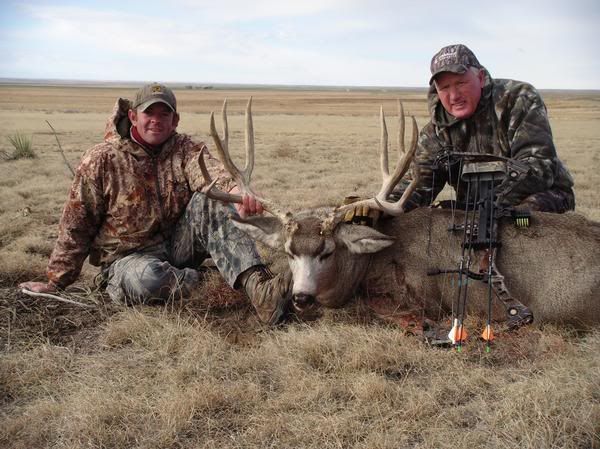
How’s this for a flatlander buck?


Photo by Patrick Montgomery (guide)

Colorado Deadline Approaching

Posted by admin on Wednesday, 1 April, 2009

April 7 is the last day to apply for limited-entry mule deer hunts in Colorado

Gunnison Herd

Posted by admin on Sunday, 29 June, 2008

By DAVE BUCHANAN
The Daily Sentinel

Wednesday, June 04, 2008

GUNNISON — You smell the deer before you see them. Tucked up in the big rocks, flopped among the riparian downfall of cottonwoods and willows, or simply lying on an open slope, legs sprawled like a marionette whose strings had been cut.

These are the remains of the deer that died around the Gunnison Basin during the past winter, an unpleasant but totally natural extension of what happens when Mother Nature takes a hand in managing wildlife populations.

No one will ever know exactly how many of deer and elk died this winter in the vast basin. The elk likely fared as elk always do in winter: They get by. Elk are big enough to survive a rough snow year, although there is some mortality every winter.

…“Only two things kill an elk — a bullet or a bumper.”

Deer, however, are the pawns in this life-and-death chess game. Fragile, thin-skinned, not big enough or strong enough to plow through deep snow and with a frustrating tendency to gather in small groups in isolated places.

The Colorado Division of Wildlife estimated there were 20,000 mule deer in the Gunnison Basin going into the winter. By the end of the feeding program, the DOW estimated 9,400 were receiving a daily ration of feed.

The fate of the rest? That’s part of why DOW terrestrial biologist Scott Wait, DOW seasonal biologist Leslie Spicer, and a curious reporter are hiking the steep hills west of Gunnison looking for deer carcasses.

Our efforts, and those of several similar teams of monitors, is to offer some statistical data about winter mortality, an effort to indicate how many deer perished in what was reported as the snowiest winter the basin has seen since record-keeping began in 1915-16.

The surveys were relatively simple. Half-mile squares were plotted with Global Positioning System accuracy on topographic maps. Each day during the weeklong survey, teams of at least two people would walk one or more plots, counting all the deer they could see along a series of compass-line transects that covered the square.

Walk a half mile, move a quarter-mile, walk a half-mile back, repeat.

Monitors counted only the carcasses seen from the transect line. While some carcasses might have been missed, it’s surprising what you can see (and smell) when looking for a dead deer.

That initial transect was at the Beaver Creek State Wildlife Area, which was expected to have the highest carcass count of all transects. Of the 131 feeding sites around the area, Beaver Creek was the busiest, feeding an estimated 450 deer per day at the height of the program.

Normal winter deer mortality is about 15-18 percent, according to the DOW. Given the severity of the past winter, you might expect deaths to hover around the high end of the estimate.

We hadn’t reached the GPS starting point when we found (smelled) the first carcass.

“It’s out of the transect so we can’t count it,” Wait said. “I think we’ll find others.”

Sometimes the carcass would be up in the rocks, and Wait surmised the deer died huddled next to sun-warmed boulders or while scraping for forage revealed by melting snow. Sometimes the bodies were scattered on an open slope, simply toppled over where death overtook them.

Most of the carcasses were found near the creek, where steep slopes fell into a creek bottom jammed with jackstrawed trees and leg-trapping willows. Any winter-weakened deer that somehow fell or slipped into the jam of logs would have little chance of escape. It was in those tight quarters we found most of the 89 carcasses we counted on the transect.

That’s nearly 20 percent of the deer reportedly being fed, high but not way outside the estimate. And given the conditions, not surprising, either.

“Deer will use willows and trees for thermal cover and some of these probably were looking for some relief when they got down here,” Spicer said. “But you can see how the willows were bent over from the weight of the snow, so there probably wasn’t much shelter down here.”

There were a lot of fawns, which was expected, but few mature bucks, which runs counter to the theory that older bucks, stressed by rut and running nearly on empty, are among the first to die in a tough winter.

Other counters may have found more buck carcasses but those results aren’t yet available.

The other three surveys in which I participated, two along the deer-rich slopes of Cochetopa Creek east of Gunnison and the last in the Hartman Rocks area south of town, turned up very few carcasses. On the Cochetopa, one of those surveys had four carcasses, the other had three.

At Hartman Rocks, also a feeding site, there were four deer carcasses and one pronghorn carcass.

The final tally won’t be exact, since exactitude is a rarity in wildlife management anyway. But it may help biologists better understand the health of the deer herds and equally important, the health of the land.

No one yet is drawing any conclusions. But it’s likely thousands of deer survived the winter thanks to the efforts of the DOW and the diligent volunteers who went out for 130 straight days to toss down bags of feed. Also, thousands more deer survived by finding south-facing slopes where snow cover was lighter.

But many deer died, and in response to local outcry, the Colorado Wildlife Commission drastically reduced doe hunting licenses for this fall in the Gunnison Basin.

Colorado Limited License Drawing Deadline – April Fools Day

Posted by admin on Thursday, 3 April, 2008

Colorado Hunt Application Deadline 

The limited license draw deadline is April 1. A new resource for you, the Colorado Hunting Planner (PDF), is a one-page summary of season dates, fees and application dates and deadlines. It can be saved and printed for easy reference as you plan your hunt. Also available is a map of GMUs highlighting Colorado’s 3.3 millions acres of wilderness! (7.1MB, PDF) For more information on season dates for 2008 – 2009, see the 5-yr season structure document, which was adopted in November 2004.

Colorado App Deadline Approaching

Posted by admin on Saturday, 22 March, 2008

Colorado Mule Deer Hunt Application Deadline

April 1 is the deadline to apply for Colorado Mule Deer

Get more info Click here