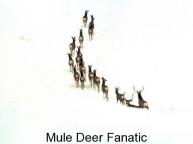
Last chance to impact Idaho Mule Deer Management

Idaho has published a Mule Deer Management plan that will be in force for the next decade. If you want your voice to be heard, here is the link: COMMENTS.
—————————————–
My comments to Idaho: “None of Idaho’s units have anywhere near the mule deer they should have. Every single one of the units should be marked “increase”. Overall, mule deer numbers are at about 1/3 of what they once were. That is pretty sad for a state with so much potential. Stop killing does and fawns until the REAL carrying capacity is reached.
I estimate that predators are killing 150,000 (or more) mule deer in Idaho each year. There is nothing more important to managing mule deer than predator control, and yet it is almost totally ignored. Why do you bury your heads in the sand about this issue when no other problem comes anywhere close in its severity? All the rest of your goals are fluff, and expensive fluff at that, if you do not address the predator problem.
Suppose I was in business having old customers that were leaving me, and that my products and service were so bad that I could not obtain any new customers. How do you think it would work if I then paid good money to recruit new customers while collecting that money from the old customers and while giving the old customers even less product/service? That is exactly what you are doing.”
——————————————
Some of my observations about the plan:
1) The plan will spend a lot of money and accomplish very little
2) Money will be spent to recruit new hunters (while old hunters have been severely restricted) instead of spending money to have more deer
3) In 12 goals, only one mentions predator control, and it is only short-term control at that.
——————————————
HERE ARE THE “GOALS”
Goal #1: Provide mule deer hunting opportunities that reflect the preferences and desires of hunters, including maintaining annual hunting opportunity and increasing opportunity for mature buck hunting experiences.
- Example Strategies:
- Maintain general hunting to allow annual hunting opportunity with family and friends.
- Provide additional mature buck hunting opportunity, equitably distributed throughout the state (e.g. some quality or trophy hunting available in each region).
- Provide for a balance of motorized and non-motorized hunting experiences.
Goal #2: Maintain healthy and productive mule deer populations proportionate to habitat capabilities.
- Example Strategies:
- Manage mule deer populations below carrying capacity to promote healthy populations, including optimal buck recruitment.
- Use antlerless harvest conservatively to achieve population goals.
- Monitor for, and manage against, disease.
Goal #3: Implement predator management actions when and where appropriate to aid in achieving management objectives.
- Example Strategies:
- Increase mountain lion harvest short-term following significant declines in mule deer populations.
- Continue to direct Animal Damage Control Board coyote removal efforts.
Goal #4: Encourage recruitment of new hunters and retention of existing hunters.
- Example Strategies:
- Continue providing either-sex opportunity for youth.
- Develop simple and easily understood hunting regulations.
Goal #5: Fully implement the Mule Deer Initiative Action Plan.
- Example Strategies:
- Continue devoting additional personnel and funding to accomplish on-the-ground projects to benefit mule deer.
Goal #6: Improve and protect habitat.
- Example Strategies:
- Improve or protect more than 50,000 acres of habitat annually.
- Increase Department involvement in landscape scale land-use planning.
- Promote livestock management practices that benefit mule deer habitat.
Goal #7: Evaluate a cost-effective and reliable habitat monitoring program.
- Example Strategies:
- Develop a management tool that can be used to improve habitat and population management efforts.
Goal #8: Reduce illegal harvest.
- Example Strategies:
- Increase targeted enforcement efforts, especially on mule deer winter ranges.
- Provide training and information to other law enforcement agencies to increase awareness of poaching and commercialization.
- Reduce illegal outfitting and guiding for mule deer.
- Promote citizen involvement in enforcement issues.
Goal #9: Improve population monitoring programs.
- Example Strategies:
- Monitor mule deer population size, body condition, age structure, fawn production and survival, adult survival, and buck:doe ratios annually.
- Develop short-term and long-term total population objectives for discrete mule deer populations.
Goal #10: Work with landowners and sportsmen to minimize and mitigate for depredations.
- Example Strategies:
- Increase the use of permanent solutions to address chronic depredation problems.
- Encourage use of youth, seniors, hunters with disabilities, and veterans for harvesting depredating deer.
- Distribute information to agricultural producers on how to minimize depredations.
Goal #11: Implement special investigations to improve population and habitat management capabilities.
- Example Strategies:
- Conduct an in-depth analysis of the impacts of varying season length and timing on buck survival.
- Determine long-term impacts of noxious weeds, fire, and habitat change on mule deer populations.
Goal #12: Provide information and improve public understanding of, and involvement in, mule deer management.
- Example Strategies:
- Increase distribution of mule deer information via newspaper articles, internet, public meetings, radio, television, direct mail, e-mail, and workshops.
- Distribute educational materials promoting the relationship between hunting and wildlife conservation in Idaho.
- Increase opportunities for public involvement including public meetings, internet, conservation organization meetings, and e-mail
——————————————
Draft Plan Population Goals
The state has been divided into 15 mule deer population management units (PMUs) consisting of one or more game management units. Population management units were based on seasonal movements of deer, habitat characteristics, and similar management priorities. Short-term population goals are likely to be met within one to three years simply through hunting season structure, assuming normal precipitation and snow conditions. Long-term population goals are designed to be achieved in three to 10 years and are dependent on implementing a number of management strategies within the plan, particularly habitat improvement projects.